

| Feature | What it involves | Planning use |
|---|---|---|
| Purpose | Moves homeless individuals and families toward permanent housing | Treat the stay as a bridge and work toward a move-out from the start. |
| Length of stay | Typically three months to three years; agreements often carry a maximum term of 24-36 months, depending on funding source | Ask the provider for the exact maximum term before accepting a place. |
| Agreement | Signed lease or occupancy agreement with an initial term of at least one month | Read the terms on renewal, rules and ending the stay. |
| Services | Tailored supportive services, usually offered at a single site | Say which needs matter most so the services fit you. |
| Who is served | Often limited groups, such as deinstitutionalized individuals, people with disabilities, families with children, or people fleeing domestic violence | Check that a program’s target group matches your situation before applying. |
The definition comes from the HUD User glossary, and the stay length, agreement and service details come from Colorado’s transitional housing guidance.
What is transitional housing? It is temporary housing paired with tailored supportive services that moves homeless individuals and families toward permanent housing, with a time limit that depends on the program and its funding.
For the wider range of choices, including shelters and other interim options, see emergency housing options after losing your home. This guide stays with how transitional housing is defined, who it serves and how a stay unfolds.
What a stay means in practice
Transitional housing is a step along a route, not a place to settle. The National Alliance to End Homelessness (NAEH) describes it as not permanent housing and not intended for indefinite stays, and calls entry a temporary point along the pathway rather than an endpoint. That shapes several decisions.

- Treat the time limit as a planning date. Colorado says transitional housing typically remains time-limited to stays of three months to three years. Los Angeles County lists it as temporary housing for up to 24 months, and NAEH says stays may run up to 24 months with limited exceptions. Work backward from the limit when you plan savings, income and the next home.
- Expect more privacy than a shelter, with more structure. Colorado describes transitional housing as more private and longer-term than emergency shelter, but still time-limited. That suits someone who needs a stable base while resolving specific barriers, and less so someone who needs only a few nights of shelter.
- Ask about the funding source. Colorado notes that the maximum term varies with the funding behind a program. Two programs in the same city can therefore allow different lengths of stay, so compare the written terms rather than assuming a standard limit.
- Judge a program by its exit goal. Colorado states the aim as interim stability and support to overcome discrete barriers to independent permanent housing. A program that cannot explain how its services connect to that goal deserves more questions.
Because the stay is built around an agreement, the next question is what that agreement and the house rules require.
Rules and agreements residents face
Residents typically hold a signed lease or occupancy agreement. Colorado says it has an initial term of at least one month, renews automatically, and carries a maximum term typically of 24-36 months, depending on funding source. NAEH adds that participants should understand their rights, responsibilities and landlord-tenant protections, so ask for the document in writing and read it before signing.
Rules differ by program. Colorado says tenancy should be directed through participant choice, with services based on self-identified need. It also notes that under some models, people who do not participate in programming, comply with rules or engage in certain behaviors may be asked to leave. Before moving in, ask directly:
- Is participation required? Some models expect residents to take part in programming, and the consequence of declining can be a request to leave.
- What conduct rules apply? The agreement should state them, along with what happens if a rule is broken.
- How does renewal work? Automatic renewal still stops at the maximum term, so confirm that date.
Eligibility and populations served
Eligibility turns on the program’s target group. The HUD glossary says transitional housing includes housing primarily designed to serve deinstitutionalized homeless individuals, people with disabilities, and families with children. Colorado adds that providers often serve limited populations, such as people fleeing domestic violence or people in sober living. Los Angeles County lists the housing for individuals or families, with or without children.
In practice, a general description of eligibility matters less than whether a particular site serves your group. NAEH says placement should go through Coordinated Entry, so contacting your local homelessness response system is usually more productive than approaching sites one by one.
Two situations often call for a different first step. Someone leaving an abusive home may need a specialized program, and how to get into a domestic violence shelter covers that route. Young adults leaving the care system have their own options, set out in housing for youth aging out of foster care.
How it differs from shelter and permanent housing
The HUD glossary defines transitional housing by its purpose: a project that facilitates the movement of homeless individuals and families to permanent housing. That purpose separates it from the options on either side.
- Emergency shelter. Los Angeles County describes crisis housing as emergency shelter intended to help people quickly exit to permanent housing. It is the first stop and the most immediate, whereas transitional housing is longer and more private. Colorado calls transitional housing an intermediate step between emergency shelter and permanent housing.
- Transitional housing. Temporary housing with a package of supportive services, usually at a single site, aimed at removing specific barriers.
- Permanent housing. The destination. A stay ends successfully when someone moves here.
The wider system pursues the same aim. Fulton County describes the Continuum of Care Program as designed to promote a community-wide commitment to the goal of ending homelessness. It funds efforts to quickly rehouse individuals, families, youth and people fleeing domestic violence, and aims to optimize self-sufficiency. Transitional housing is one of several tools in that effort, so it does not suit everyone: a household that can move straight into permanent housing may not need it.
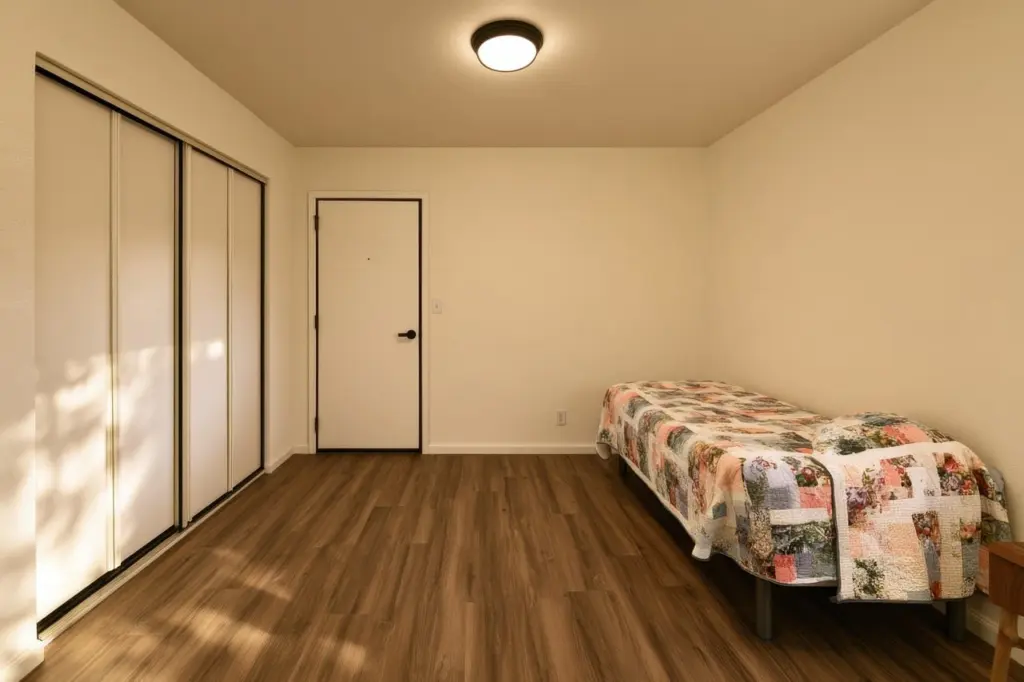
Supportive services during the stay
Supportive services are what distinguish transitional housing from simply renting a room. Colorado describes a specific package of tailored services offered where the housing is, and says services should follow participant choice and self-identified need. NAEH recommends progressive engagement: start with minimal services and increase only as needed.

For a resident, this means the service plan should reflect your goals rather than a fixed checklist. If a program assigns the same schedule to everyone, ask how it adjusts to individual need. Raising a concern early is easier than adjusting after a rule has been broken.

From intake to move-out
A typical stay follows a sequence, though details vary by program and funder.
- Placement and intake. Placement ideally runs through Coordinated Entry. At intake the provider confirms that you fall within its target group.
- Agreement. You sign the lease or occupancy agreement, which sets the term, the rules and your rights as a tenant.
- Plan and housing search. NAEH advises beginning the permanent housing search on entry and working the plan throughout the stay, rather than waiting until the end.
- Services at the right level. Services start light and grow only if you need more, based on what you identify as your needs.
- Move-out. NAEH says transitional housing should end when someone secures permanent housing that meets their needs and that they can maintain long term.
The stay can also end another way. Under some models, as Colorado notes, residents who do not participate or comply may be asked to leave. Reaching the maximum term without a home lined up is the other risk, which is why the early housing search matters.
Frequently asked questions
Can a stay go beyond the usual time limit?
Sometimes. NAEH says stays may run up to 24 months, with limited exceptions, and Colorado says the maximum term in agreements is typically 24-36 months, varying by funding source. The agreement you sign states your own limit.
Does transitional housing count as permanent housing?
No. NAEH describes it as not permanent housing and not meant for indefinite stays. It is a temporary point on the pathway to a home you can keep.
Do residents have to take part in services?
NAEH says services should be available and responsive but not a condition for entering the program or being exited from it. Colorado notes that under some models, residents who skip programming or break rules may be asked to leave, so confirm the policy of the specific program.